
Añahani—Ereba-making: An Afro-Indigenous Foodway in Honduras, Belize, and Guatemala

Historical Perspective
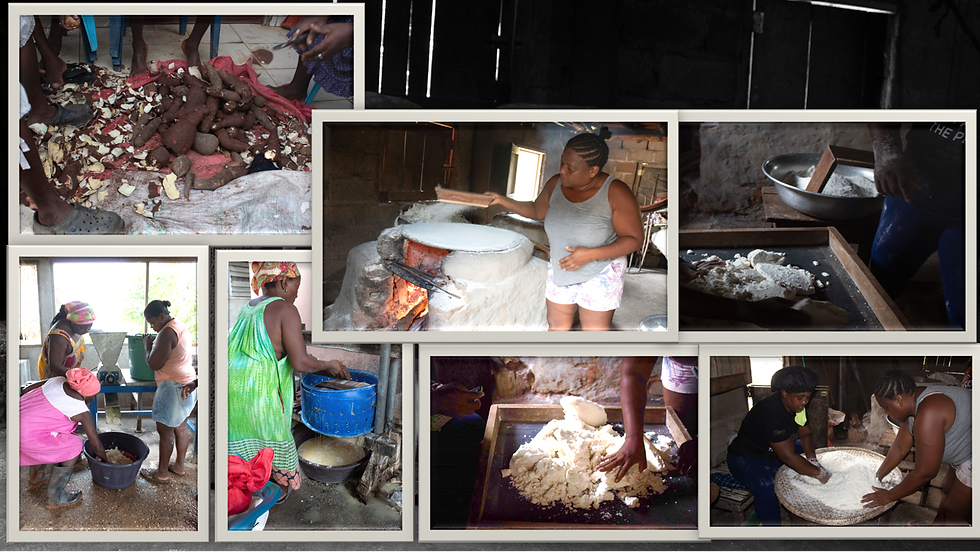
Ereba-Making is a symbol of continuity, a food-making practice that carries the memory of migration, displacement, resistance, and empowerment. For Garifuna communities, making casabe remains one of the most recognizable counter-hegemonic expressions of resistance to identity erasure.
Garifuna, a community of African and Ameri-Indian peoples in Honduras, Belize, and Guatemala, originated in the Caribbean. They learned survival mechanisms, such as gathering and preparing food, from the Arawak tribe on the island of Saint Vincent and the Grenadines in the XVI century.
The Caribs on the Island of Saint Vincent engaged in “unspecialized nonhorticultural subsistence practices … [and] share dependence upon bitter manioc as a carbohydrate base. Although other cultivated plants are used by these tribes, only bitter manioc seems to be of consistent year-round importance. Carib subsistence practices thus include a specialized agricultural economy that contrasts with the nonspecialized, seasonal food-collecting endeavors. The use of the tipiti (manioc sleeve press) as a processing tool is ubiquitous among the Guiana Carib tribes, but is replaced by the mat strainer and heavy ceramic tub among the Xingu Caribs. All Carib groups who process bitter manioc do so in such a way as to obtain both "flour" (actually precipitated starch granules, not a product of grinding) and soup. All groups use the "flour" to prepare large tortilla-like cakes upon a ceramic griddle…” (Basso, 1977, p. 13-15).

Comments